

What is Meibomian Gland Dysfunction (MGD) ?
The Dry Eye Center of Maryland has helped patients, from Columbia and all around Maryland, with Meibomian Gland Dysfunction (MGD) and specializes in the treatment of dry eye since 1975.
If your eyes are feeling dry and bothering you, it’s very important to have a thorough dry eye examination to properly diagnose the cause(s). If you have more than one condition (e.g. dry eye, allergies, blepharitis, ocular rosacea, meibomian gland dysfunction (MGD), contact lens-related issues, conjunctivochalasis, Demodex, other) it is imperative that each is identified and properly treated.
Meibomian Gland Dysfunction (MGD) is a chronic, diffuse abnormality of the glands in your eyelids known as meibomian glands. Meibomian gland dysfunction is often associated with blepharitis, ocular rosacea, and/or Demodex. The meibomian glands are oil-producing glands in both your upper and lower eyelids. The oil produced by these glands forms the outermost layer of your tear film. This oil layer protects your tears from rapidly evaporating. When these oils are reduced or eliminated, your tears evaporate from the surface of your eyes quickly and your eyes become much drier. This is especially true when you are engaged in visually intense tasks such as reading (books, magazines, newspapers), staring at a computer, cell phone, or tablet screen, watching television, driving, etc.
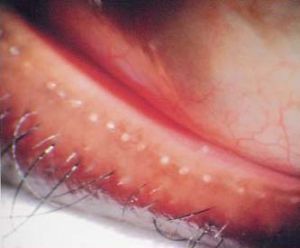
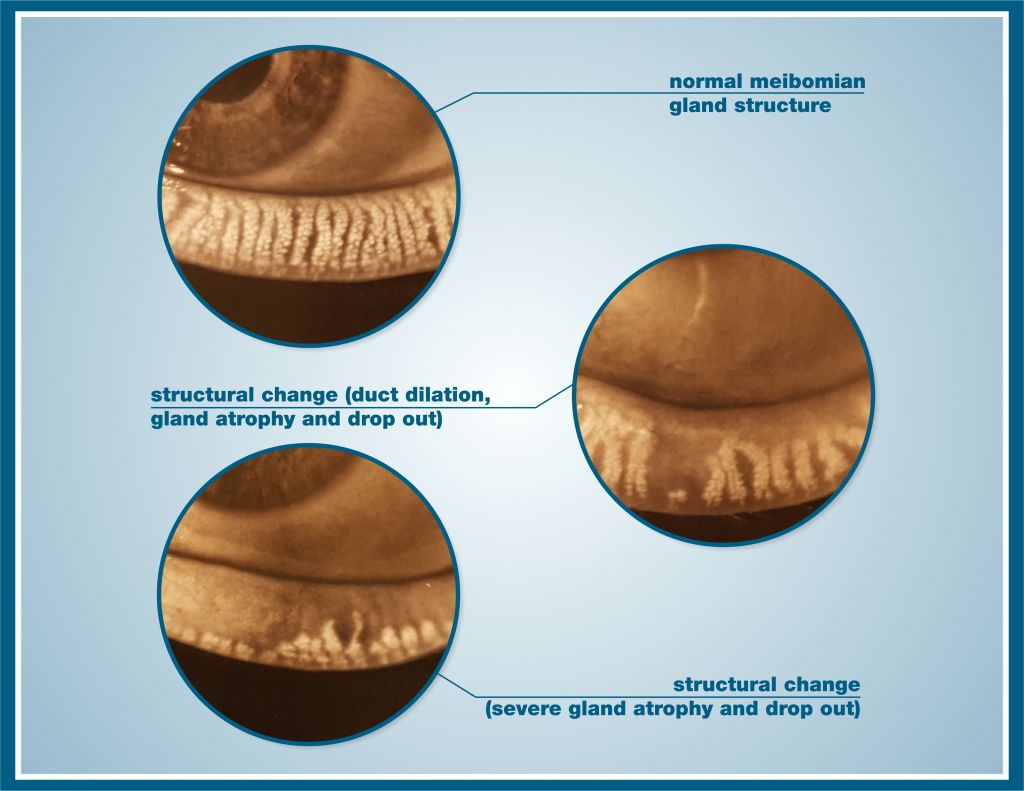
When the meibomian glands are healthy, the oil they produce has the consistency of olive oil. When the glands are inflamed, the oils they produce become thickened, having a consistency more like that of toothpaste, leading to clogging of your meibomian glands. When your meibomian glands become clogged, the oil layer is not contributed to your tear film; your eyes become drier, and more irritated and inflamed. This inflammation causes damage to the surface of your eyes and your tear producing glands. Additionally, the back pressure caused by the clogging of your meibomian glands results in damage to the glands, with gland shortening, atrophy and death.
Untreated, meibomian gland dysfunction is chronic and progressive. Allowed to progress, the damage to meibomian glands is irreparable and can lead to significant discomfort with dry, red, irritated and inflamed eyes, recurrent infections, scarring of the surface of your eyes, and decreased vision.
Unfortunately, lost meibomian glands do not have the ability to spontaneously regenerate.
Blepharitis, ocular rosacea, and meibomian gland dysfunction are very closely related. They all cause damage to your meibomian glands secondary to inflammation, thickening of the meibomian glands’ contents, clogging of the glands, decreased oil production, and the accumulation of a biofilm on your eyelids.
Symptoms of Meibomian Gland Dysfunction (MGD)
Many people with meibomian gland dysfunction (MGD) are completely unaware that they have any issue, while others have one or more of the symptoms.
Common Symptoms caused by Meibomian Gland Dysfunction (MGD) Dry Eye include:
- Lid infections
- Crusted eyelashes
- Dryness of the eye
- Sandy or gritty feeling
- Flaking of the skin around the eyes
- Burning, itching
- Contact lens discomfort
- Blepharitis
- Light sensitivity
- Redness, sties
- Tired Eyes
- Eye pain or soreness
- Constant or occasional tearing
- Fluctuation of vision
We'll Diagnose
Meibomian Gland Dysfunction (MGD)
Let’s get to the point and figure out if you have Meibomian Gland Dysfunction (MGD) dry eye and what’s causing it. The EYEBIOMETRICS® EVALUATION determines the form of dry eye, tear film abnormalities, and identifies potential Meibomian Gland Dysfunction (MGD) treatment strategies. Careful clinical observation, accurate diagnosis, and appropriate intervention can eliminate or minimize the deleterious effects of Meibomian Gland Dysfunction (MGD) and ocular surface disease for quality of life and providing relief.
We'll Treat &
Manage It
Once we diagnose your Meibomian Gland Dysfunction (MGD) dry eye, we will develop a treatment plan that is customized just for you. Regardless of what you may have been told before, you can benefit from a successful Meibomian Gland Dysfunction (MGD) treatment plan that will relieve the pain, itching, and vision problems associated with Meibomian Gland Dysfunction (MGD) and dry eye. We can return you to clear vision and easy sight. We have relieved dry eye for thousands of patients and we will do it for you.
Lid Hygiene for
Meibomian Gland Dysfunction (MGD)
Patients with Meibomian Gland Dysfunction (MGD) are commonly afflicted with crusted eyelashes and lids causing dryness and infections. While there are many different levels of Meibomian Gland Dysfunction (MGD) treatment,lid hygiene has been the standard of care for Meibomian Gland Dysfunction (MGD). Thousands of patients have been helped with lid hygiene, which is used to exfoliate the eyelid, removing debris that can build up over time causing obstruction and loss of your meibomian glands. Poor lid hygiene can lead to chronic lid disease and discomfort and Meibomian Gland Dysfunction (MGD). Early detection and intervention is essential to the long-term health and comfort of your eyes.
Relief From
Meibomian Gland Dysfunction (MGD)
With the right treatment plan we can treat your Meibomian Gland Dysfunction (MGD) dry eye. There are many options for treating Meibomian Gland Dysfunction (MGD) and we utilize our vast knowledge, experience, and latest technology to customize a treatment plan that is tailored for each individual patient. Meibomian Gland Dysfunction (MGD) and dry eye therapies can include, artificial tears and lubricating eye drops, over-the-counter (OTC) and/or prescription eye drops, BlephEx, lid hygiene, lid margin debridement to remove bacteria, biofilm, and Demodex mites from your eyelids and open clogged meibomian glands, and many more treatment options.
Schedule Your MGD Dry Eye Consultation Today
(410) 291-1718
From the moment an individual walks into the office, The Dry Eye Center of Maryland demonstrates that they are geared to serve. The receptionists greet patients with a smile, ask about their families, and offer something to drink. The waiting time is never long, but if it is, there are plenty of current magazines with which to entertain oneself. When one does go back, the General Vision Examstechnicians treat clients with respect and explain each step of the tests. Finally, once patients see the doctors–who are professional in every definition of the word–they are again greeted warmly and treated with respect. The entire experience is life changing, and I wouldn’t go anywhere else.
Thank you for your help in getting me fitted with and adjusted to contact lenses. Apparently my “dry eye” condition has made it difficult and at times impossible for me to wear contacts in the past. Now with your help I am comfortable in my contacts. As you may remember, I am a high school senior and have tried to wear contacts in the past, not only for esthetic reasons but to help me in various sports/activities (football, lacrosse, surfing, etc.). In the past I am not sure that the eye care people I saw recognized or appreciated my “dry eye” condition. Moreover, they clearly did not address this problem. As such, I remember having great difficulty getting my contacts in and even more difficulty in trying to remove them. In the past, I was never comfortable wearing contacts. Your work with my tear ducts and other techniques you have used to correct my “dry eye” condition has made an incredible difference. The process that we have gone through to prepare me for contact lenses has made a tremendous difference. Now I am exceedingly comfortable wearing my contacts and find that they provide me with much improved vision. Again, many thanks for your help. Very truly yours.
I have been wearing contact lens for 55 years. When I moved from out-of-state to Maryland, I needed to find a new contact lens specialist. I found Dr. Azman using a Google search. I was surprised to get a phone call asking me questions before getting an appointment. It turns out Dr. Azman specializes in problem cases. As I described my increasing discomfort and dry eyes, he said he could help. I never had the tests he did for tear layer, the topography of cornea, etc. I discovered my contacts were not fitting properly causing an abrasion on both eyes. After two weeks of no contacts, the abrasion was healed. I was surprised when he suggested soft contacts. My previous doctor thought I couldn’t wear them after years with hard and then gas permeable lens. Switching to the soft lens was no problem. It took some adjusting of different strengths of the lens to get the correction for reading and computer work, but now I am very happy with the results. I could not drive at night with contacts because of the extreme glare. That is gone. My eyes were very sensitive to light so I needed sunglasses all the time. That is gone.
OMG….where do I begin. First and foremost, Dr. Azman saved my daughter’s eyesight, not once, but twice! At the age of 6 my daughter’s Rx was dramatically changing every 6 months (unheard of) and she was getting headaches and couldn’t read for more than 15 minutes at a time. No one could figure out what was wrong. One visit to Dr. Azman and we were on our way to healthy eyes!!! All it took was a few quick tests and Dr. Azman had my daughter diagnosed with dry eyes. Life was good for many years until we moved to PA and lost contact with Dr. Azman (never again!) Recently I received a distressed call from my daughter, now age 20, with problems with her eyes. She had crystals forming and pushing through her eyes, infections in her eyes, she couldn’t go out in the sunlight, etc. and FOUR different specialists in PA kept giving her steroids and antibiotics with the explanation of “we don’t know what causes it”…I even told them about her dry eyes and was blatantly told I didn’t know what I was talking about. !!!???!!! Dr. Azman to the rescue AGAIN! Within two visits my daughters eyes cleared up and well on their way to healing. She’s back to normal with her nose stuck in a book every evening after sitting in front of a computer all day @ work even! Dr. Azman is simply amazing. He met with us in the late evening hours since we are out of town and even on a HOLIDAY!!! I wish more people could be as caring and giving as Dr. Thomas Azman. We refer him every chance we can! We will never be able to thank you enough.
I have been under Dr. Azman’s treatment for my dry eyes. He is very attentive and thorough – always giving detailed explanations and answering all my questions in a way that I am able to fully understand. Dr. Azman also contacts me if there is a new treatment or medication that he feels would improve my condition. I will admit that sometimes there is an extensive wait in the office, but I can only assume he is giving other patients the same detailed care that he is giving me! The Azman staff is very gracious and lovely – always greeting me with a smile and genuinely asking how I am. The office itself is very clean and the communication between the different areas seems to flow smoothly. I highly recommend Dr. Azman due to his attention to detail and his expertise!
I have tried contact lenses on four different occasions, without success, before I visited Dr. Azman. Although other doctors had told me I had dry eyes, their solution was to simply prescribe a different brand of contact lens rather than to address the underlying problem. On each occasion, the end result was that the lenses bothered me so much that I just stopped wearing them. Dr. Azman’s commitment to correcting the dryness in my eyes was a refreshing and effective approach to my vision issues. For the first time, I feel that contact lenses will actually be a viable choice for me. It’s fantastic.
Dr. Azman has been my eye doctor for more than 25 years. Recently he has treated my eyes for dry eyes. He is very thorough and extremely knowledgeable about treating dry eyes. I didn’t know how bad my eyes felt until he treated them. Even though I wear contacts, my vision was slightly impaired due to dry eyes. Once Dr. Azman started treatment, my eyes felt so much better and my vision changed again due to improvement of moisture in the eye. I put my trust in Dr. Azman.
“I have been under Dr. Azman’s care for the treatment of dry eyes. He is very attentive and thorough – always giving detailed explanations and answering all my questions in a way that I am able to fully understand. Dr. Azman also contacts me if there is a new treatment or medication that he feels would improve my condition. I will admit that sometimes there is an extensive wait in the office, but I can only assume he is giving other patients the same detailed care that he is giving me! The Azman staff is very gracious and lovely – always greeting me with a smile and genuinely asking how I am. The office itself is very clean and the communication between the different areas seems to flow smoothly. I highly recommend Dr. Azman due to his attention to detail and his expertise! He is a truly an expert in dry eye treatment.”
“I have been dealing with severe dry eyes for years. Have been to a dozen of eye doctors with no success. All the eye doctors kept telling me the same things over and over again. I was about to give up until I read all the good reviews about Dr. Azman and his team, so I decided to give him a try. All I can say is I’m glad I did. I have nothing but great things to say about him and his staff. Very helpful and very friendly. My dry eyes have nearly been treated after years of pain! I can’t thank him enough for what he did for me. After each treatment he would follow up and call me to see how I was doing. No other doctor has ever called me to follow up. I was never rushed and he answered all my questions. I would highly recommend Dr. Azman and his team. I can honestly say he exceeded all my expectations. Thank you Dr. Azman for all your help!”
“I was told I could not wear contact lenses by 3 other eye doctors due to my dry eyes. You did concur that I had dry eyes, but you introduced me to Orthokeratology. You explained your Precision Accelerated technique to me. Even though I was a little skeptical about it ,because I never heard of it, I decided to trust you. I also looked into lasik and was told I could have it. After researching lasik and dry eyes I learned that if you have dry eyes you should not have lasik surgery. It has now been 2 years since going through your procedure and I am still experiencing comfortable, clear vision all waking hours. Thank you Dr. Azman for guiding and educating me and protecting my eyes from having Lasik which could of been a disaster. You have changed my life.”
“I want to express my appreciation for helping me. I came to your office with a problem that I could not identify. However, I did recognize that my eyes were chronically tired and red, and I had to wear my glasses all of the time. Today, I am experiencing a high level of comfort and I feel as if my eyesight has improved. When I arrived for my first appointment, Joanne met with me to acquaint me with your practice and to administer preliminary tests. She was very informative and reassuring. Next, I met with you and again I was reassured that it would be possible to correct the difficulties I was experiencing. You carefully and clearly explained the results of the preliminary evaluation and then conducted your own. I had worn contact lenses prior to coming to you. It was a disaster. I was prescribed a more generic lens and along with the dry eye problem, the lenses were never really correct. I was not able to read with the lenses and my distance vision was poor as well. Eventually I gave up, as these lenses were apparently the only option available to me. My experience at the Azman Dry Eye center was completely different. Dr. Azman devised a plan of attack. Which eventually led to success with contact lenses. Other eye centers did not address any specific problems; they only evaluated my eyesight and wrote prescriptions for glasses or generic contact lenses. I also want to say that the level of caring that is shown to patients from the front desk to the doctor himself, is above any I have experienced elsewhere. It is a pleasure to come to the office. I will continue to recommend the practice and Dr. Azman to my friends and family. Thank you for all your help.”
Dr. Azman was able to stop the pain from a dry eye condition by using this new technology called Prokera and other treatments. Highly recommended!
I have been suffering for two years with dry eye pain and worry. From the time I walked in the door the experience was great. The staff was so kind and made me feel so welcome. Doctor Azman was patient and kind and took so much time with me and diagnosing my issues. I actually got in the car and cried tears of joy after the visit feeling hope for the first time. Best feeling I have felt in years, a big thank you to him and the staff!
Dr. Azman is wonderful! He is very thorough and makes sure that his patients understand everything in terms of their eye care. The office staff is friendly and very helpful. I highly recommend Dr. Azman and Azman Eye Care Specialists.
If you are experiencing issues or problems with dry eyes, this is the place to be. Very thorough service with a caring and compassionate doctor and team.
The Azman practice gives their clients customized service. As a client I feel like I am practice’s one and only client. Also, the technology and knowledge of optical research they utilize is second to none!
I Love Dr Azman! He is very gentle, caring and professional! I wouldn’t want to see any other eye Dr in the world!!!
I have been suffering with eyes pain and inflammation around 5 months ago after I visited many specialists and the problem continued….finally I saw Dr. Benjamin Azman, he diagnostic me DRY EYE and gave me the right treatment. I feel much better thanks God! Dr.Benjamin and his father are so kind. God Bless them! I recommend Dr. Azman. They’re great.
Of the handful of doctors and offices I have visited with regard to my dry-eye issue, Dr. Azman and his group have been, by a long-shot, the most hospitable, empathetic, and helpful with my issue. Dr. Azman didn’t rush me through the process of diagnosis, like other offices. He took the time to sit with me and discuss some of the root causes of my issue, and answer any of my concerns. In subsequent follow-up appointments, he performed several procedures that have been helpful to me and that have given me hope that there is a way to manage this condition. I would recommend him to anyone. And if you are using eyedrops frequently, and have never had your issue seriously looked at, please get it checked out before you do more damage to your eyes.
Hope for dry eyes! Dr. Azman was able to stop the pain from a dry eye condition by using this new technology called Prokera and other treatments. Highly recommended!
I have been suffering for two years with dry eye pain and worry. From the time I walked in the door the experience was great. The staff was so kind and made me feel so welcome. Doctor Azman was patient and kind and took so much time with me and diagnosed my issues. I actually got in the car and cried tears of joy after the visit feeling hope for the first time. Best feeling I have felt in years, a big thank you to him and the staff!
Always a great experience at The Dry Eye Center of MD. The staff is polite and professional, and Dr. Azman knows eyes better than the other eye doctors I’ve been to. They take the time to figure out the issue and make sure no details are missed! Thank you!
I would like to take this opportunity to thank you for all your help. When I visited your office in April, I was particularly impressed with your state of the art equipment and for the care and concern you showed me. Since I was from New Jersey, you went out of your way to see me on the weekend (twice on Sunday). You made me feel special and more like a friend than a patient. Your follow-up telephone calls really meant a lot to me. Your recommendations for treatment of my dry eye problems are working; I highly recommend that anyone with eye problems seek you out.
-Carol K. Secaucus, New Jersey